
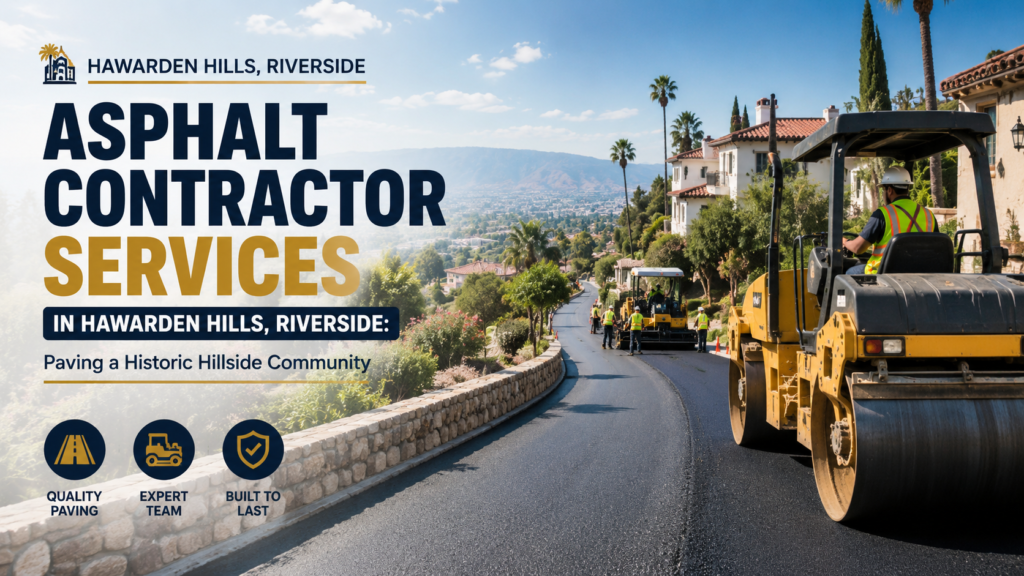
Hawarden Hills is one of Riverside, California oldest and most established hillside neighborhoods, a community of 1.48 square miles just south of downtown that has been part of Riverside since the city original incorporation in 1883. Named for Hawarden Castle in Flintshire, North Wales a name brought to the area by English settlers who developed neighboring Arlington Heights Hawarden Hills features streets that wind and flow with the area naturally hilly terrain, six major arroyos including the Alessandro Arroyo running through the southern section of the community, and a wide variety of single-family homes ranging from early twentieth-century citrus-era estates to newer construction along corridors like Victoria Avenue. With some of the highest property values in Riverside and a mix of historic landmark homes alongside more recent development, Hawarden Hills presents Asphalt Contractor Hawarden Hills contractors with both the technical demands of hillside terrain and the quality expectations of an established, prestigious community.
Hawarden Hills Distinctive Terrain
The defining physical characteristic of Hawarden Hills is its naturally hilly landscape, shaped by the six arroyos that run through the community, including the Alessandro Arroyo in the southern section and steeper, more rugged inclines toward the eastern part of the neighborhood. Streets in Hawarden Hills curve and follow the natural elevation changes of this terrain rather than the grid pattern common in flatter Riverside neighborhoods, meaning that driveways and private roads throughout the community regularly navigate meaningful grade changes, curves, and varied sub-grade conditions across what can be relatively short distances.
This terrain creates specific paving considerations for Hawarden Hills properties: driveways on the community steeper inclines benefit from surface texture specifications that maintain traction in wet conditions; drainage design must account for the way water moves across hillside lots and toward the arroyo system that defines the neighborhood; and base preparation must be tailored to the specific sub-grade conditions found at each property, which can vary meaningfully across a community with such varied topography.
A Mix of Historic and Contemporary Paving Contexts
Hawarden Hills building stock spans more than a century, from early citrus-era estates including the Tudor Revival-style Orchard House built between 1917 and 1920 through mid-century development between 1970 and 1990, to newer construction along Victoria Avenue and in some of the community more recently developed gated enclaves. This range creates a correspondingly varied set of paving needs:
- Historic estate properties: Many of the community oldest homes, dating to the early twentieth-century citrus industry era, have driveways and access roads that may be due for resurfacing or replacement after decades of service, often requiring an approach that respects the historic character of the surrounding property while bringing the paved surface up to current performance standards.
- Mid-century residential properties: Homes built between 1970 and 1990 throughout the community typically have driveways approaching or past their original design service life, frequently presenting good candidates for resurfacing if the underlying base remains sound, or full replacement where base failure has occurred.
- Newer development along Victoria Avenue and gated communities: More recently constructed homes generally have driveways requiring routine maintenance sealcoating and crack sealing rather than full reconstruction, though quality original installation varies and should be assessed individually.
Inland Empire Climate Considerations
Hawarden Hills experiences the same Inland Empire climate profile as the broader Riverside area hot, dry summers with limited freeze-thaw activity in winter. For asphalt pavement, this means UV oxidation of the binder is the dominant long-term aging mechanism, making regular sealcoating (generally every 2 to 3 years) the single most effective maintenance practice for extending driveway service life throughout the community. Summer heat also means that asphalt mix specifications appropriate to the Inland Empire temperature range sufficiently stiff to resist rutting and surface deformation under the high pavement-surface temperatures common during Riverside summers are important for any new installation or resurfacing project.
Drainage and the Arroyo System
The presence of six major arroyos running through Hawarden Hills makes thoughtful drainage design a particularly important consideration for paving work throughout the community. Properties adjacent to or near these natural drainage features must ensure that driveway and access road grading directs water appropriately without contributing to erosion in the arroyo channels or creating drainage conflicts with the natural watercourse system that has shaped the neighborhood landscape for well over a century. Asphalt contractors working in Hawarden Hills benefit from understanding this drainage context and designing paving projects that work in harmony with the area established natural drainage patterns.
HOA Variability in Hawarden Hills
One notable characteristic of Hawarden Hills, distinguishing it from many other upscale Riverside hillside communities, is that a substantial number of the area older, established estates and historic properties operate without any homeowners association or associated fees, giving these property owners considerable direct control over exterior improvements including driveway paving. However, certain newer subdivisions and gated enclaves within or near the broader Hawarden Hills area do operate under HOA governance, particularly where private road maintenance is a shared community responsibility. Property owners should confirm their specific property status before planning significant paving work, as the regulatory and approval pathway differs meaningfully between HOA-governed and independently owned parcels in this community.
California Contractor Licensing
Asphalt contractors performing work in Hawarden Hills must hold a current California Contractors State License Board (CSLB) license with the Class C-12 (Earthwork and Paving) classification. Given the significant property values and the mix of historic and contemporary homes throughout the community, property owners should verify license status, bonding, and insurance before engaging any contractor for driveway or private road paving work.
Conclusion
Asphalt contractor services in Hawarden Hills must navigate one of Riverside most historically significant and topographically distinctive hillside communities a neighborhood where citrus-era estates sit alongside contemporary construction, where six arroyos shape both the landscape and the drainage demands of every paving project, and where the absence of HOA governance on many older properties gives owners direct responsibility for maintaining their pavement to a standard worthy of the community century-plus legacy. Understanding the area varied terrain, climate-appropriate maintenance needs, and the historic character that defines so much of Hawarden Hills equips property owners to plan paving projects that serve both function and the neighborhood enduring character.